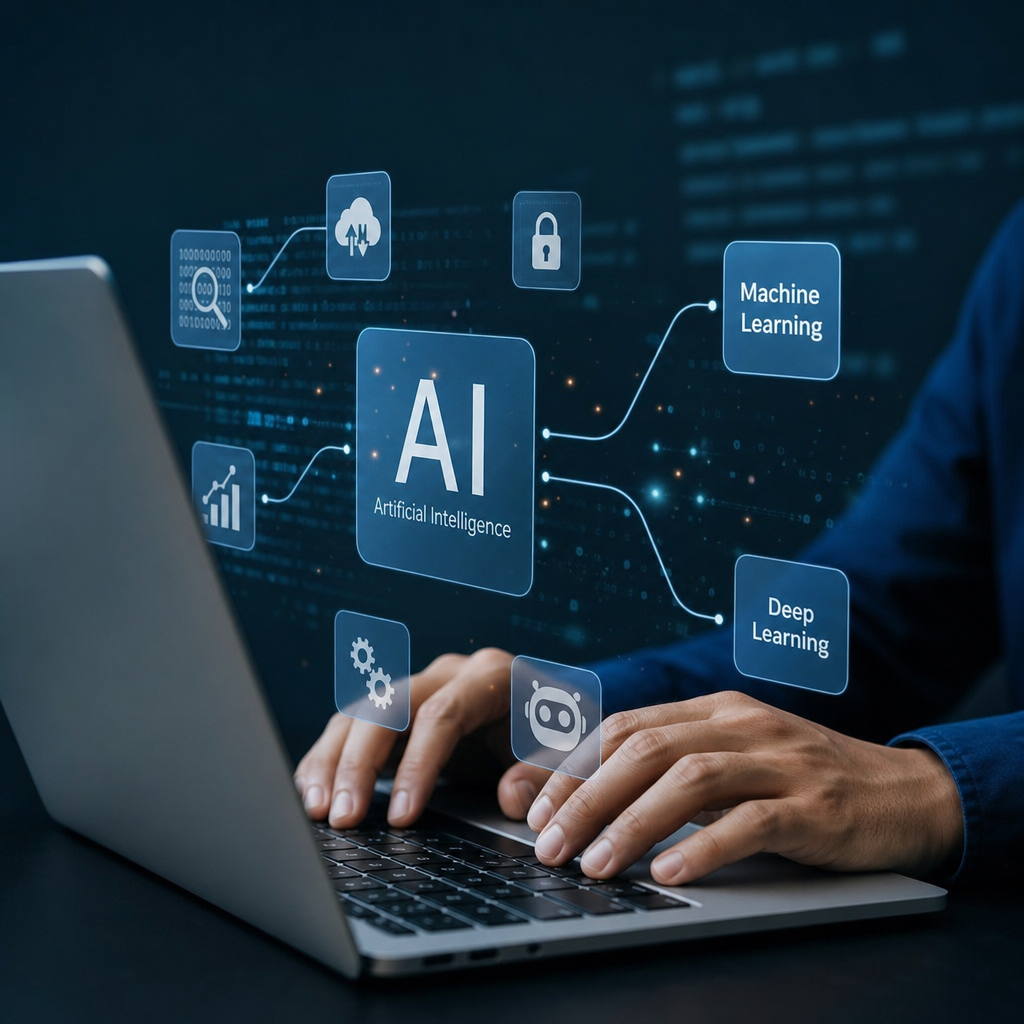
Exploring the Intricacies of AI & Machine Learning
Picture a world where machines not only understand human emotions but also anticipate our needs. This is not a sci-fi plot but an emerging reality powered by the intricate sciences of Artificial Intelligence (AI) and Machine Learning (ML). Their impacts ripple through various sectors, dismantling old paradigms and presenting new opportunities.
As these technologies evolve, they challenge traditional narratives in business, healthcare, and beyond. The tapestry of AI and ML is woven with threads of promise and complexity, each unraveling stories of transformation and innovation. In this post, we delve into the foundational constructs, transformative applications, and future trajectories of AI and ML.

Understanding AI and Machine Learning: A Brief Overview
AI and ML often go hand-in-hand, but they are not identical. AI is an umbrella term that encompasses systems or machines that emulate human intelligence. ML, a subset of AI, focuses on enabling machines to improve their decision-making over time without explicit programming.
The Building Blocks of AI
- Natural Language Processing (NLP): This allows machines to interpret and respond to human language, enabling more intuitive human-computer interactions.
- Neural Networks: Modeled after the human brain, these networks enable machines to process complex data through interconnected nodes.
- Computer Vision: This empowers machines to interpret and make sense of visual information from the world.
Machine Learning Models
Central to ML are the models trained to make predictions or decisions. These range from simple linear regressions to complex deep learning models that analyze massive datasets.
Transformative Applications in Various Industries
Healthcare
AI and ML are revolutionizing healthcare by enhancing diagnostic processes and personalizing patient care. Predictive analytics helps in early disease detection, thus saving lives.
Finance
In the financial sector, AI algorithms assess credit risks, detect fraud, and power high-frequency trading systems, contributing to more secure and efficient financial transactions.
Retail
Retailers leverage AI for inventory management and personalized marketing, ensuring stocks are optimized and customers receive tailored product recommendations.
Future Trajectories of AI and Machine Learning
As AI and ML capabilities grow, ethical implications and concerns around AI bias and data privacy become more pronounced. Addressing these concerns is crucial to sustainable advancement.
Tabular Representation of AI/ML Growth Sectors
| Sector | Current Impact | Future Potential |
|---|---|---|
| Healthcare | Diagnostics, Personalized Medicine | Predictive Healthcare, AI-assisted Surgery |
| Finance | Fraud Detection, Credit Scoring | AI-driven Personalized Financial Portfolios |
| Retail | Inventory Management, Personalized Marketing | Real-time Trend Analysis, Customer Behavior Prediction |
Conclusion
The journey of AI and ML is just beginning. As these technologies integrate more deeply into the fabric of society, their potential will be shaped by innovation and ethical considerations. With careful orchestration, they promise advancements that could propel humanity into a new era of capabilities.